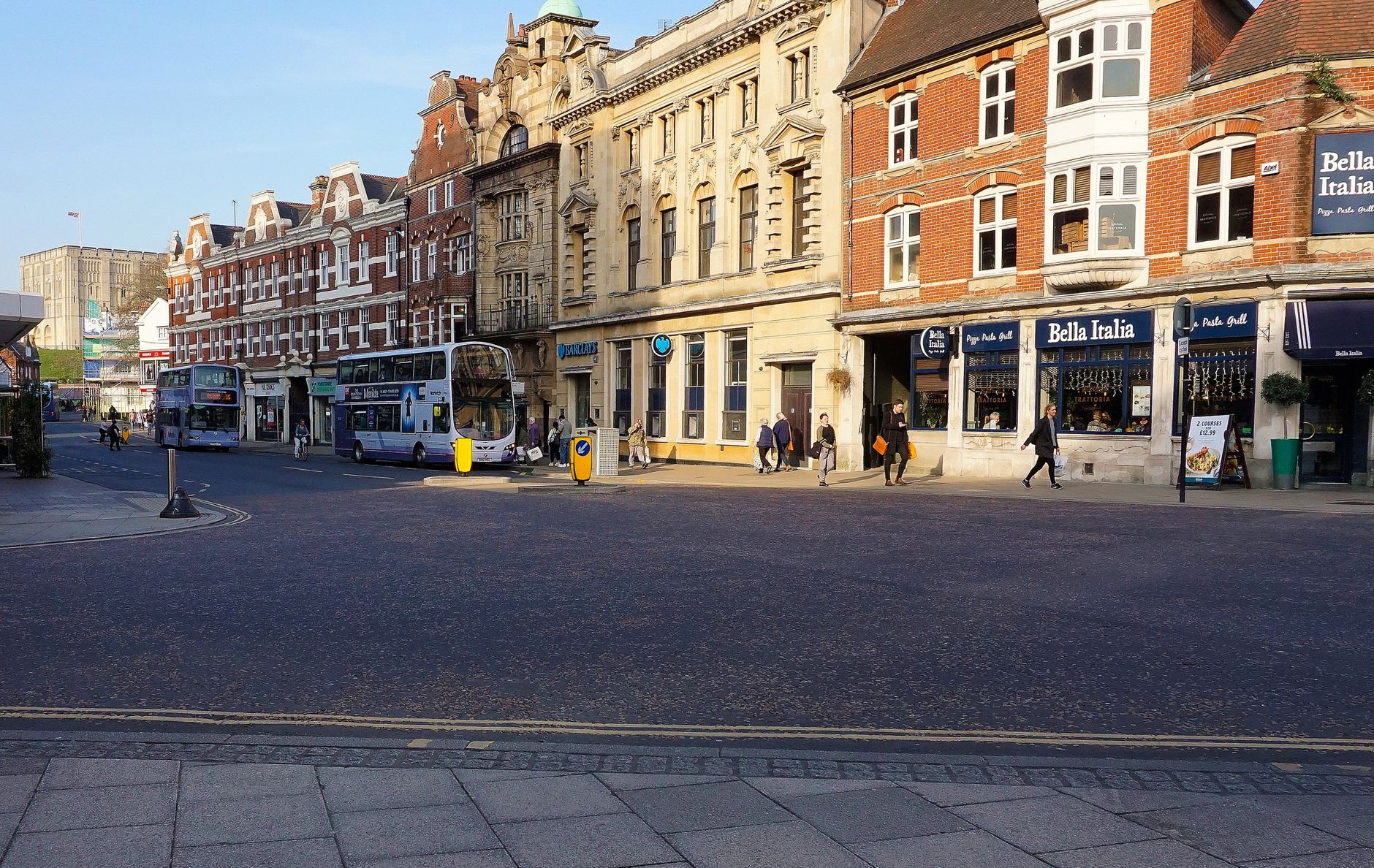
General safety
Reading is safe by day and mostly safe by night. Violent crime against visitors is rare; the more common issues are bag theft in the Oracle at weekends, phone snatches on Friar Street after pub closing, and drunk aggression outside nightclubs after 2am. Standard city rules apply: keep your phone off the table in busy pubs, don't leave bags on chair-backs, and use a card in ATMs on well-lit streets.
Thames Valley Police runs regular weekend patrols along Friar Street, Broad Street and the station approach, and a volunteer Street Pastors team is often out from around 9pm to 3am on Friday and Saturday nights, handing out water and helping anyone who has had too much to drink. CCTV coverage across the pedestrianised centre is dense, which is one reason crime here trends toward opportunist theft rather than anything more serious. If something is stolen, report it to a police officer on the beat or call 101 promptly, since insurance claims and lost-property returns both need a crime reference number. Keep valuables close inside the Oracle's bars and along the Riverside strip, where distraction thefts spike between 11pm and 1am on Fridays.
Areas and times to be aware of
The Oxford Road corridor west of the station is the most-discussed area — it's fine to walk during the day and to eat at the many good Turkish, Nepali, and Caribbean restaurants along it, but it feels sketchier after 11pm than the centre does. Cemetery Junction and parts of West Reading after midnight can be uncomfortable on foot alone. The centre itself, Caversham, and Kennet-side are consistently fine.
Southampton Street and the lower stretch of London Road toward Whitley share the same profile as Oxford Road — busy and unremarkable by day, quieter and best avoided solo after midnight. Christchurch Bridge, the pedestrian crossing linking the centre to Caversham, is well lit and heavily used even late, so walking back to a Caversham hotel or flat after dinner is not a concern. Forbury Gardens and the area around the Reading Abbey ruins are unlit and empty after dark, worth a daytime visit only. If your accommodation sits off Oxford Road itself, a five-minute taxi rather than a fifteen-minute walk after midnight is the sensible call, and fares rarely run past £8 within the town.
Practical numbers and habits
999 for emergency (police, ambulance, fire), 101 for non-emergency police, 111 for non-emergency NHS medical advice. Royal Berkshire Hospital on Craven Road has 24-hour A&E, 10 minutes by taxi from the centre. Store your hotel address in your phone. If you're out drinking late in the centre, use Uber or a black cab from a marked rank at the station rather than walking home alone through the Oracle car park area.
For anything short of a real emergency, the Urgent Treatment Centre attached to Royal Berkshire Hospital deals with minor injuries and infections without the A&E wait, typically under two hours even on a Saturday night. Boots on Broad Street and the pharmacy inside the Oracle both keep extended evening hours for over-the-counter medicine. Photograph your passport and travel insurance policy number and keep copies in cloud storage, since replacing documents from a UK police station is straightforward but slower without them. Reading's main taxi ranks sit outside the station on Station Approach and on Friar Street, both marshalled at weekend closing time.
Getting around after dark
Trains from Reading station run GWR, CrossCountry, South Western Railway and Elizabeth line services, with the last departures toward London and Basingstoke typically between 11:30pm and 12:30am on weeknights and slightly later on Fridays and Saturdays — check the board rather than assume, since engineering works regularly shift the last few services. Local Reading Buses routes thin out sharply after 11pm and there is no dedicated night bus network, so late travel across town means a taxi or Uber far more often than public transport. Uber coverage is reliable across the whole borough, and a cross-town fare rarely exceeds £9.
Walking the towpath along the Kennet or the Thames after dark is not recommended even for short stretches, since lighting is patchy past the Blake's Lock area and phone signal drops in places. Stick to Bridge Street, Duke Street and the main pedestrianised loop, all of which stay lit and populated until the last pub crowds clear around 1am. If you're catching an early train, the station's forecourt taxi rank is staffed from around 5am, and pre-booking a car for anything before that with a firm rather than hailing on the street is the more reliable option.
Solo travellers and lone women
Reading is a comfortable town for solo travel by day, and central hotel areas around the station and Oracle stay busy enough at night that walking alone before midnight is unremarkable. Bar and restaurant staff in the centre are used to solo diners and will call a taxi without being asked if you look uneasy leaving late. Trust your instincts around Oxford Road and Cemetery Junction after midnight the same way you would in any UK town of this size — cross the road or step into a lit shop doorway if someone follows rather than confronting them directly.
The Street Pastors scheme mentioned earlier is specifically there to help anyone, not just those who look intoxicated, and they'll wait with you for a taxi if you flag one down near Friar Street on a weekend night. If you'd rather not walk the ten minutes from a late train, the station taxi rank is the better £6-8 spend than testing an unfamiliar street alone. Solo women booking accommodation should weigh a hotel's distance from the station as heavily as its price, since that short stretch is where most late-night discomfort actually happens.
Money, cards and common scams
Contactless and card payment is near-universal across Reading; several bars around Friar Street and the Oracle are effectively cashless, and carrying more than £40-50 in cash is rarely necessary. Card skimming at ATMs is uncommon but not unheard of — use machines attached to banks on Broad Street or inside the Oracle rather than free-standing ones in side streets. The most persistent low-level scam isn't theft at all but unlicensed minicab touts who approach arriving train passengers directly on the station forecourt offering rides; they're not part of the marshalled rank and prices are unregulated.
Politely decline and walk the extra twenty metres to the official taxi rank or open the Uber app instead. Street charity collectors and clipboard fundraisers along Broad Street are legitimate but persistent; it's fine to simply say you're not stopping. If a card reader in a smaller independent café seems to be asking for an unusually high tip percentage by default, check the screen before confirming — this is a minor annoyance nationwide, not a Reading-specific problem, but it catches distracted travellers.
Where you stay changes how much of this matters
Picking accommodation within a few minutes of the station removes most of the late-night walking this guide is cautious about. Premier Inn Reading Central, at roughly £70-90 a night, sits close to both the station and the Oracle with 24-hour reception, making it the sensible budget pick for late arrivals. Malmaison Reading, around £110-140, and the Hilton Reading Hotel, around £100-130, both sit within a couple of minutes of the station forecourt — the Hilton in particular means stepping from a lit taxi rank straight into a staffed lobby, which is about as low-risk as a late arrival gets.
voco Reading and Novotel Reading Centre both fall in the £90-120 range and sit inside the pedestrianised loop, a reasonable middle ground if you'd rather be near restaurants than the station itself. Crowne Plaza Reading by IHG and ibis Reading Centre offer similar central positioning at a range of price points. If you're arriving off a late train from Heathrow or London and don't want to think about any of the above, book something within the station's 400-metre radius rather than saving £15-20 on a room further out near Oxford Road.
Questions, answered
Is Reading safe for tourists?
Yes, broadly safe. The main risks are pickpocketing at weekends and drunk-related incidents late at night in nightlife areas.
Is it safe to walk from the station to town at night?
Yes, it's a lit 5-minute walk. Later than 1am on weekends, take an Uber if you feel unsure.
Which areas should I avoid?
None to avoid outright by day. After midnight, the far end of Oxford Road and outer Cemetery Junction are worth skipping on foot.
What's the emergency number in the UK?
999 for emergencies, 101 for non-emergency police, 111 for medical advice.
Is Oxford Road safe to eat on at night?
Yes for dinner — the restaurants there are popular and well-lit into the evening. The caution is about walking through after 11pm, not sitting down for a meal at 8pm.
Are taxis and Uber reliable in Reading?
Yes. Uber operates widely across the town and licensed black cabs queue at marshalled ranks outside the station and on Friar Street. Avoid unlicensed minicab touts who approach you directly on the station forecourt, since their fares aren't regulated.
Doing good is the business: every booking through Stay Reading funds one verified tonne of carbon removal — same room, same price, no markup.
Start your search